A book for founders · by Paraag Amin

Claude at Human Pace

AI does not set the pace. It accelerates whatever pace it finds. This book shows you how to put Claude to work across the money, the growth and the operations of a small business, and how to stay the kind of founder for whom the acceleration is a gain.

£14£29Launch price
Launch price until 31 August 2026. Digital edition, 92 pages, sixteen figures, three practical appendices.
Claude
at Human
Pace
Paraag Amin
Start here

Read Chapter One, free

The AI Acceleration Problem: what AI is actually doing to founders, why it arrives hardest at the worst moment, and the one distinction the whole book is built on. Enter your details and the chapter arrives by email.

Thank you. Chapter One is on its way to your inbox.
Oops! Something went wrong while submitting the form.
You will also receive occasional updates when this page changes. Unsubscribe any time.
For readers

The living half of the book

Interfaces change. Books do not. The book carries the durable thinking; this page carries the perishable specifics, current screenshots, click-by-click setup, and corrections as the product evolves. Everything below carries a date, so you know it is current.

Appendix A, kept current

Getting set up

The current path from nothing to a working Claude inside your business. Companion to Chapter Three and Appendix A of the book.

1. The plan and the desktop app

Verified 25 July 2026

Choose a paid plan at claude.com/pricing, download the Claude desktop app, and sign in. The work in this book happens in Claude Cowork, inside the desktop app, not in a browser tab.
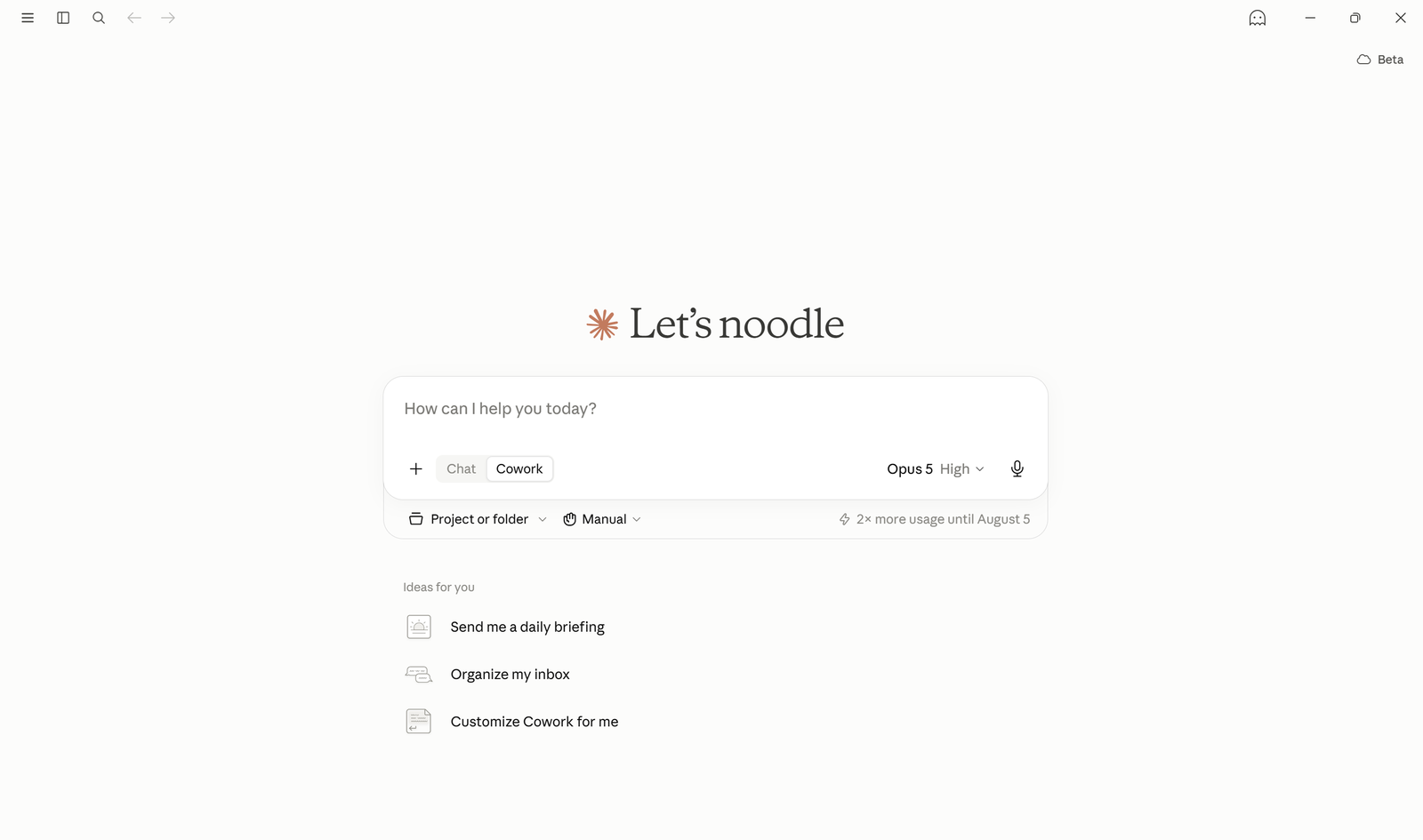
The Claude desktop app open in Cowork, showing the task box and the Chat and Cowork modes

2. The Small Business plugin

Verified 25 July 2026

Install the Claude for Small Business plugin from the plugins directory, then turn it on with the toggle inside Cowork. It is a plugin, not a separate product or price.
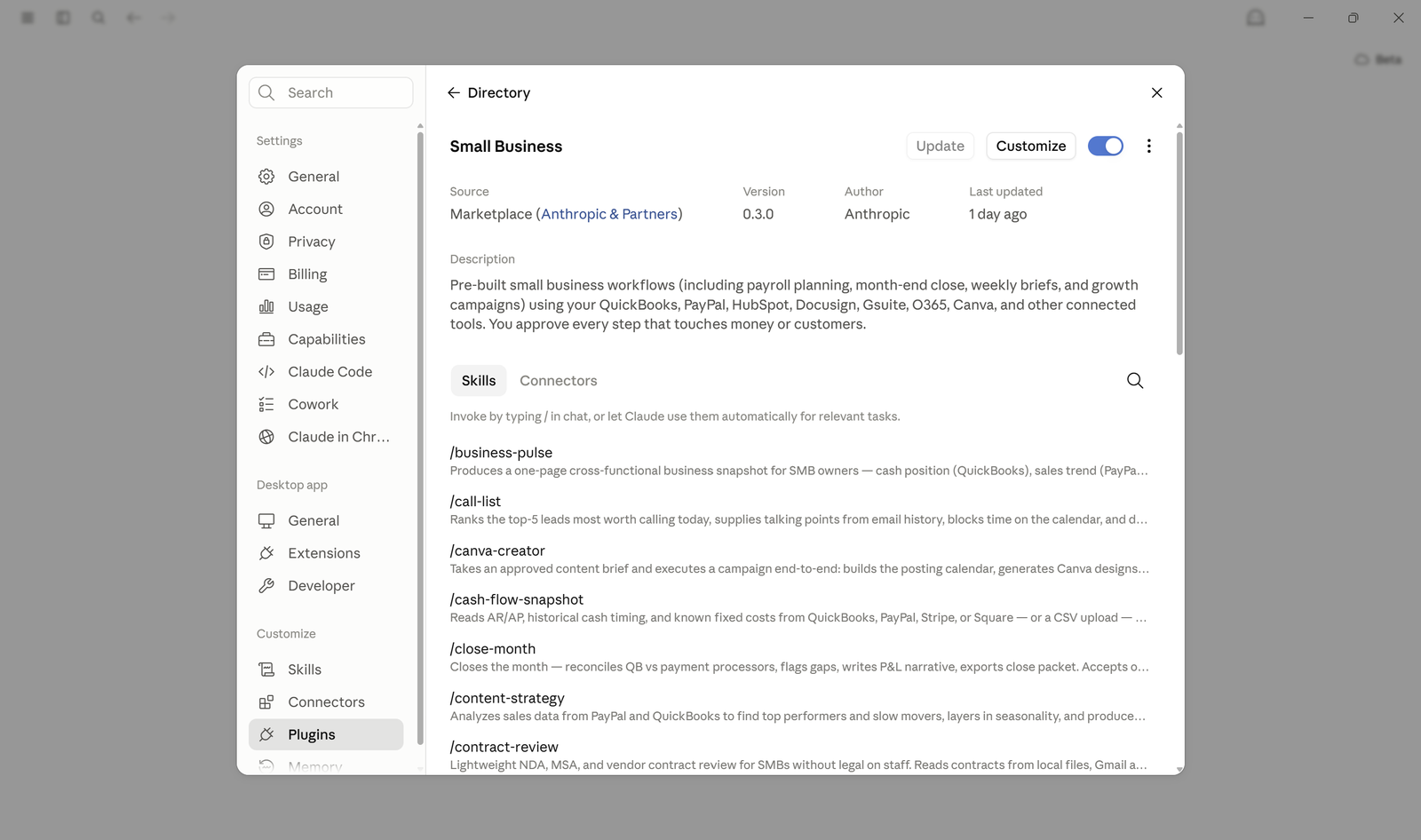
The Small Business plugin in Claude settings with its toggle switched on, showing version and skills

3. The first prompt

Verified 25 July 2026

Ask Claude, in plain language, to get you started. It walks you through connecting your first tools and running your first workflow. When stuck, ask Claude itself, including how to do things in Claude.
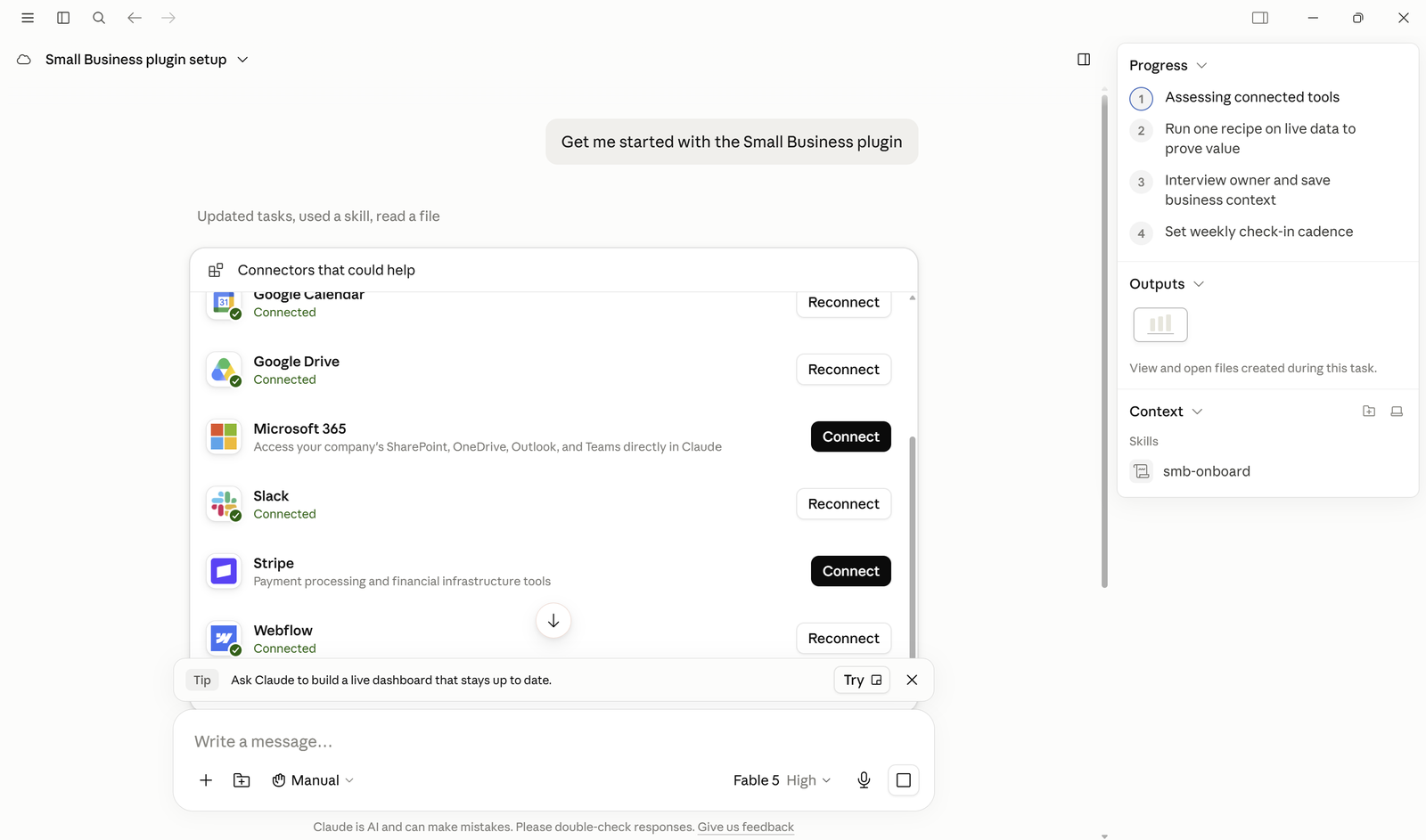
A Cowork conversation starting with Get me started with the Small Business plugin, showing the setup plan and connector list
Appendix B, kept current

Connecting your tools

Every connection is a button and a login. The order below is the book’s argument in practice: context tools first, customer tools second, money and commitment tools last. Connect each on the day you have a use for it.

The walkthrough, and it is the same for every tool

Verified 26 July 2026
1
In Cowork, ask Claude to help you connect a tool, or open the Connectors panel. During setup, Claude presents the list itself, as the screenshot in Getting Set Up shows.
2
Find your tool in the list and press Connect.
3
Log in to that tool in the window that opens and approve access. It is the tool’s own secure login: Claude never sees your password.
4
That is the whole thing. The tool shows Connected, and Claude inherits the permissions you already have there, nothing more.
A connection takes about a minute. Disconnecting is the same panel and the same minute, so nothing you connect is a commitment. If a tool you use is missing from the list, ask Claude in plain language whether it can connect to it, since the list grows.

Connect first · context

Tier 1

Email, calendar, documents, website. Low stakes, and you know what good looks like: learn to read Claude’s work here. Typical tools: Gmail or Outlook, Google Calendar, Google Drive or OneDrive, your website platform.

Connect second · customers

Tier 2

Customer system, design, messaging. Connect when there is a real first use, and stay present at the human moments. Typical tools: HubSpot, Canva, Slack.

Connect third · money

Tier 3

Accounting, payments, contracts. Point a trained eye at these, and keep the approval moment real. Typical tools: QuickBooks, PayPal, Stripe, Docusign.

Part Two, kept current

What the plugin currently ships with

The book teaches the workflows by shape, because the catalogue changes. This is the live catalogue, checked against Anthropic’s published materials.

The money

Verified 25 July 2026

Payroll planning and 30-day cash forecasting, month-end close and the accountant packet, overdue invoice chasing, margin analysis, tax-season preparation.

Growth

Verified 25 July 2026

Lead triage and prioritisation, campaign analysis from your customer system, on-brand asset generation in your design tool.

Operations and people

Verified 25 July 2026

The Monday-morning business pulse, contract review before signing, employee onboarding, customer service handling.

For UK readers

Running it from the United Kingdom

The product launched with an American accent; the capability works here. The connected tools are global products, the workflows handle sterling and cross-border transactions, and this author runs it from London. Where a workflow assumes an American context, tax season is the obvious one, treat the shape of the workflow as the lesson and your accountant as the authority. UK-specific notes and any regional differences are logged below as they are found.

July 2026
Page live. UK installation confirmed working on a London-based account.
Honesty in print

What has changed since printing

The book was verified against Anthropic’s published materials at the time of writing. When the product moves, the change is logged here, so the book stays true even where it is no longer current.

July 2026
First edition published. No corrections yet.
26 July 2026
Setup screenshots added to the Getting Set Up section: Cowork, the plugin toggle, and the get-started flow, captured from a live UK installation.
26 July 2026
Connection walkthrough added to Connecting Your Tools: the four steps, verified live, are the same for every connector.
Appendix C, usable

The instruments

The pieces of the book you actually use, in copyable, downloadable form.

Copy

The weekly diagnostic prompt

Act as a reflection partner for my weekly diagnostic.

The framework is Human Pace, which has four phases: sustainable pace, functional override, compounding override, and forced reckoning. The diagnostic is not a list of fixes. The output is an accurate reading of where I have actually been operating this week.

I will tell you about the week in my own words. Ask me four to six questions in sequence, one at a time. Use the questions to surface the gap between what I am telling you, what I was telling myself at the time, and what the body and the operating environment were reporting. Do not soften. Do not give me solutions. Do not produce a summary unless I ask for one.

At the end, give me your reading of which phase I was in this week, with the specific evidence from what I said. If I push back on the reading, hold it unless I produce evidence that genuinely contradicts it.

Once a month, in addition to the weekly reading, ask me the two standing questions: what is my exit strategy, and what is my dream outcome and why. If my answers to those questions have shifted from a previous month, name the shift.

The four operating-review questions

What is Claude doing in this business, listed plainly? Which of it did I choose, and which arrived by drift? Are my three windows, the numbers, the voice, the ground truth, genuinely open? What am I doing by hand that should be handed over next?

The four phases, on a page

The Human Pace framework as a printable one-page PDF.

Download the one-pager

The five habits, on a page

The weekly practice as a printable one-page PDF.

Download the one-pager
The author

Paraag Amin

Three decades in investment banking, C-suite and boardroom roles, including more than a billion pounds of equity raised, technology IPOs, and an AIM-listed CFO seat. Paraag now works with entrepreneurs who feel stuck in taking their business to the next stage, reworking the strategy and the person running it as one system, so they get a plan they can act on and a business that grows again.

The thinking in the book, applied to your business

Every engagement begins with a Diagnostic workshop: a day spent mapping the business and the person running it as one system, closing with a written report you can act on.

Explore the Diagnostic
The book

Claude at Human Pace

The frame, the workflows, the disciplines, and the harder questions underneath them. 92 pages, sixteen figures, three practical appendices, and this page, kept current, for as long as the book is in print.

£14£29Launch price
Launch price until 31 August 2026.
Buy the book

Already a reader?

Get an email when this page changes: new walkthroughs, catalogue changes, corrections.

You are on the list. Updates will find you.
Oops! Something went wrong while submitting the form.